
25 June 2026
What Is a Fire Curtain? A Plain-English Introduction
Fire curtains protect large or irregular openings that a hinged door simply can't. Here's what they are, how they deploy, and where they show up in buildings.
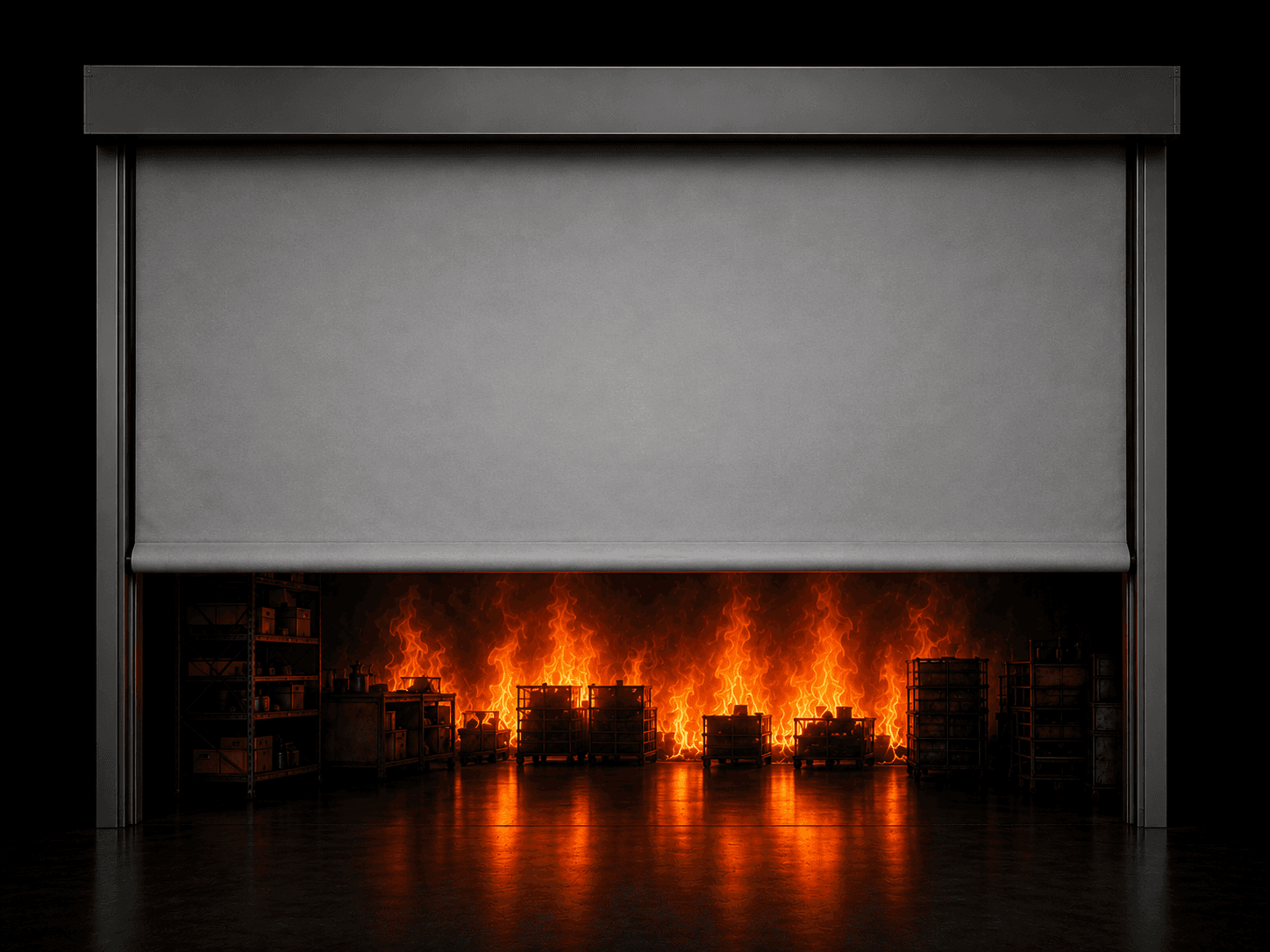
A fire curtain is a fire-resistant textile barrier, stored rolled or folded above an opening, that deploys - usually downward under gravity - to close off the opening in the event of a fire. Fire curtains exist because hinged fire doors have practical size and geometry limits: an atrium void, an escalator opening, a wide retail frontage or an oddly shaped architectural opening often can't be protected by a conventional door, but does need a fire and/or smoke barrier at that location.
How a Fire Curtain Deploys
Most fire curtains are held in a retracted, stored position above the opening during normal use, released to deploy on detection of a fire (via connection to the building's fire alarm system) or on loss of power. A defining feature of a well-designed fire curtain system is the gravity fail-safe mechanism: the curtain is designed to deploy under its own weight if power is lost, rather than requiring continuous power to close - meaning a fire curtain will close even if the fire has already damaged the building's electrical supply. Once deployed, the curtain's fabric, edge guides and bottom bar work together to form a sealed barrier across the opening, resisting the passage of fire, smoke, or both depending on the specific curtain type and its tested classification.
The Main Fire Curtain Types
- -Automatic fire curtains - deploy automatically on fire alarm activation to close a compartment opening; the most common type at atria and large internal openings.
- -Smoke curtains - tested to EN 12101-1, designed specifically to control smoke movement rather than provide full fire-resistance, often used to protect escape routes or contain smoke to a specific zone.
- -Fixed (static) fire curtains - permanently deployed, non-retracting barriers for openings that don't need to remain open during normal use.
- -Egress fire curtains - designed with a feature allowing safe passage through the curtain during evacuation even after deployment, maintaining an escape route.
- -Accordion fire curtains - fold rather than roll, allowing coverage of architecturally complex or non-rectangular openings that a standard roller curtain can't follow.
Where Fire Curtains Are Used
Fire curtains are most often found wherever a building's design calls for a large, open, uninterrupted space that nonetheless needs fire compartmentation - shopping centre atria, hotel lobbies with double-height voids, airport terminals, escalator and lift shaft openings between floors, and large retail units with wide shop-fronts opening onto a mall concourse. In each case, a hinged door either couldn't physically span the opening or would compromise the open architectural intent the space was designed around, while a retracted fire curtain is invisible in day-to-day use and only becomes a physical barrier when needed.
Fire Curtains vs Fire Doors - Different Tools for Different Openings
Fire curtains and fire doors are not competing solutions - they're specified for different geometries and use cases, and most large buildings use both. As a general rule, fire doors suit standard-width openings with regular foot traffic (corridors, stairwells, individual rooms), while fire curtains suit wide, tall, or irregularly shaped openings, and locations where the appearance of an open, uninterrupted space is part of the architectural design. A detailed side-by-side comparison of when to specify each is covered in a separate article in this Knowledge Centre.
BÖLDT manufactures automatic, smoke, fixed, egress and accordion fire curtains, tested to EN 1634-1 and EN 12101-1 and classified to EN 13501-2, with the gravity fail-safe mechanism standard across our automatic curtain range.